1. Foundation of Trust: ASTM A252 Grade 3 Quality Control
When it comes to deep foundations, quality is not an option—it is a necessity. Our ASTM A252 Grade 3 Quality Control system starts from raw material sourcing. Every coil of steel is verified for chemical composition before entering the production line. This ensures that the Steel Piling Integrity Assurance begins at the molecular level, providing a solid start for every pipe we manufacture.
2. Advanced SSAW Pipe Weld Inspection
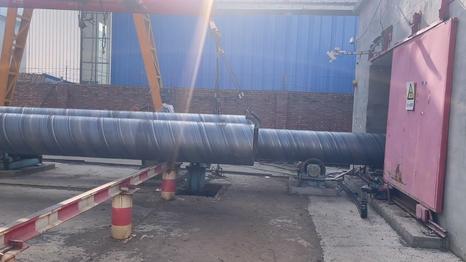
The spiral seam is the heart of an SSAW pipe. We employ a multi-stage SSAW Pipe Weld Inspection process. This includes real-time automatic Steel Pipe Ultrasonic Testing (UT) during the welding process to detect any internal flaws. To ensure 100% reliability, we supplement this with X-ray Inspection for Steel Pipe on the pipe ends and suspicious areas, leaving no room for hidden defects.
Table 1: Non-Destructive Testing (NDT) Standards
| Test Method | Coverage | Purpose |
| Ultrasonic (UT) | 100% of Weld Seam | Detect internal cracks and porosity |
| X-Ray (RT) | Pipe Ends & Critical Areas | Verify weld density and fusion |
| Magnetic (MT) | Beveled Ends / Weld Surfaces | Detect surface cracks |
3. Proving Strength: Tensile and Yield Strength Test
ASTM A252 Grade 3 requires specific mechanical properties to withstand driving forces. We conduct a rigorous Tensile and Yield Strength Test on samples from every heat number. By recording precise data, we prove our pipes meet or exceed the 45,000 psi yield strength requirement. All results are documented in the official MTC Mill Test Certificate.
Table 2: Mechanical Property Verification (Grade 3)
| Property | Required (ASTM A252 G3) | Typical Result (Our Factory) |
| Yield Strength | Min 45,000 psi (310 MPa) | 48,000 - 52,000 psi |
| Tensile Strength | Min 66,000 psi (455 MPa) | 70,000 - 75,000 psi |
| Elongation | Standard defined % | Exceeds standard by 10% - 15% |
(These verified mechanical properties directly impact the overall project budget by reducing material waste.)
4. Pressure Resistance: Hydrostatic Test for Piling Pipes
Even though piling pipes are primarily for structural use, a Hydrostatic Test for Piling Pipes is a critical indicator of weld tightness. Each pipe is filled with water and pressurized to the required level. This test ensures that the pipe can handle the extreme hydraulic pressures encountered in offshore environments or saturated soils.
5. Precision Matters: Dimensional Tolerance Inspection
A pipe that is out of spec can stall an entire construction site. Our Dimensional Tolerance Inspection covers outside diameter, wall thickness, and straightness. Using calibrated measuring tools, we ensure that every SSAW Piling Pipe fits perfectly for on-site splicing, saving our clients time and labor costs.
6. Global Standards: Third-Party Inspection (TPI) Steel Pipe
To provide absolute peace of mind, we welcome and facilitate Third-Party Inspection (TPI) Steel Pipe services from agencies like SGS or BV. This transparent approach allows our international clients to verify the quality of their order independently before shipping, ensuring the highest level of accountability.
Strict testing proves what superior raw materials provide. The successful results of our ultrasonic and tensile tests are not accidental; they are the direct result of the high-quality chemical composition found in our Grade 3 steel coils. To understand why our pipes consistently exceed industry benchmarks, one must look at the specific alloy elements that define our production. [Learn more about the chemical properties and raw material standards of our ASTM A252 Grade 3 steel.]