
1. What makes ASTM A252 Grade 3 the "backbone" of your project?
It’s all in the secret sauce of its chemistry. While other grades might compromise, Grade 3 is engineered for that perfect sweet spot—tough enough to withstand the brutal force of hydraulic hammers, yet refined enough for seamless welding. Think of it as the "heavyweight champion" of piling pipes: it offers the superior stiffness needed for deep-foundation driving, ensuring your pipes stay rock-solid and intact, no matter how tough the ground gets.
| Element | ASTM A252 Grade 3 (Max %) |
| Phosphorus (P) | 0.050% |
| Carbon (C) | Defined by manufacturing process to ensure weldability |
| Manganese (Mn) | Optimized for strength and toughness |
| Sulfur (S) | Minimal trace levels for structural purity |
2. Strength that saves you more than just worries.
When we talk about ASTM A252 Grade 3, we’re talking about the "heavy hitter" of the series. With a rock-solid minimum yield strength of 45,000 psi (310 MPa), it’s the toughest grade you can get. But here’s the real kicker: because it’s so strong, you can often use thinner walls without losing a bit of structural safety. For you, that means less weight, lower shipping costs, and a much leaner project budget—all while keeping your foundation as solid as a rock.
| Steel Grade | Yield Strength, min. (psi / MPa) | Tensile Strength, min. (psi / MPa) |
| ASTM A252 Grade 1 | 30,000 / 205 | 50,000 / 345 |
| ASTM A252 Grade 2 | 35,000 / 240 | 60,000 / 415 |
| ASTM A252 Grade 3 | 45,000 / 310 | 66,000 / 455 |
3. SSAW Process: Enhancing Material Uniformity
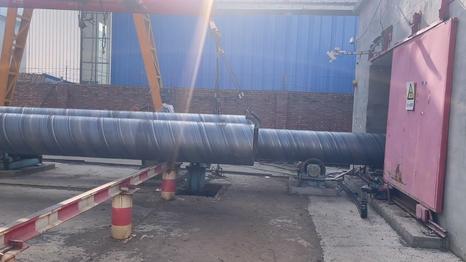
By combining Grade 3 steel with the Spiral Submerged Arc Welding (SSAW) process, we create a pipe that’s more than the sum of its parts. Think of the spiral seam as a reinforced backbone—it distributes stress much more evenly than traditional straight welds. This means no "weak spots" and no surprises. You get a consistent, high-strength piling pipe that performs reliably from the first inch to the very last.
| Parameter | Specification Range | Tolerance |
| Outside Diameter (OD) | 219mm - 3048mm | ±1% |
| Wall Thickness (WT) | 5mm - 30mm | ±10% |
| Pipe Length | Up to 50 meters (Single or Spliced) | ±25 mm |
| Straightness | Full length of the pipe | ≤ 0.2% of total length |
4. Superior Impact Resistance in Harsh Environments
Let’s face it: underground conditions are rarely perfect. Whether you're hitting unexpected rocky soil or tough geological layers, ASTM A252 Grade 3 has the "grit" to handle it. Its inherent toughness acts like a shield, preventing the pipe from fracturing or "mushrooming" under heavy impact. This means you can drive with confidence, knowing your pipe will reach the target load-bearing strata in one piece, without costly material failures.
5. Optimized Weldability for Field Splicing
One of the biggest myths is that Grade 3 steel is tricky to weld. We’ve busted that myth by ensuring our material has exceptionally low impurity levels. When your team is out in the field splicing pipes end-to-end, they’ll notice the difference immediately. Our steel allows for deep, clean penetration welds that are literally as strong as the pipe itself. No weak links, no compromises—just a continuous, rock-solid foundation from top to bottom.
6. Longevity and Corrosion Resistance Potential
We don’t just build for today; we build for decades. The superior density and smooth surface finish of our Grade 3 steel act as the perfect "canvas" for anti-corrosion coatings. Whether you’re applying 3PE, FBE, or coal tar epoxy, the material creates a bond so tight that moisture and chemicals don't stand a chance. When you choose Grade 3, you’re not just buying steel—you’re investing in a legacy that will remain rock-solid underground for generations.
The high-grade chemistry and mechanical strength of ASTM A252 Grade 3 aren’t just numbers on a datasheet—they are the reason these pipes excel in the world’s most demanding environments. Whether facing the high-pressure driving of offshore platforms or the lateral stresses of bridge foundations, this material is built to endure. [Explore our Project Case Studies and Typical Working Conditions here.]