
1. Introduction
If you are sourcing for low-pressure fluid transport or structural projects, ASTM A53 Grade B ERW is the non-negotiable standard. Reliability in the field starts with the right specs. Whether you need Schedule 40 black steel pipe or galvanized options, understanding the mechanical properties—specifically the yield strength and ERW longitudinal weld integrity—is the key to project safety and cost control.
This guide breaks down why leading A53 Gr B carbon steel pipe suppliers prioritize hydrostatic testing and how to choose between Type E and Type S for maximum ROI.
2. What is ASTM A53 Grade B ERW?
ASTM A53 is the gold standard for carbon steel pipes used in mechanical and pressure applications. Grade B is specifically engineered for higher tensile and yield strength compared to Grade A. The Type E (ERW) designation means the pipe is produced through Electric Resistance Welding—a process where longitudinal seams are joined without filler metal. This results in a clean, high-strength bond that makes it an efficient, cost-saving alternative to seamless pipes for structural use and low-pressure steam lines.
3. Why is Type E (welded pipe) more economical and easier to use than Type S (seamless pipe)?
Choosing between ASTM A53 Type E (ERW) and Type S (Seamless) is often a balance between budget and pressure requirements. Here is the technical breakdown:
-
Cost Efficiency: Type E (ERW) is significantly more affordable. Because it’s manufactured from cold-rolled steel coils, the production process is faster and less energy-intensive than piercing solid billets for Type S.
-
Precision: ASTM A53 Grade B ERW offers superior wall thickness uniformity and tighter tolerances. Unlike seamless pipes, which may have eccentric walls, ERW provides a consistent Schedule 40 profile throughout the length.
-
Strength: While Type S is rated for higher pressure, modern ERW longitudinal weld technology, combined with mandatory hydrostatic testing, ensures that the weld zone is as strong as the base metal for low-to-medium pressure applications.
-
The Bottom Line: If your project involves structural support, HVAC, or low-pressure steam, buying ERW from reliable A53 Gr B carbon steel pipe suppliers can cut your cost per ton by 20-30% without sacrificing safety.
Table 1: Mechanical Property Comparison (ASTM A53 Grade A vs. Grade B)
| Property | Grade A | Grade B | Why it matters |
| Tensile Strength (min) | 330 MPa (48,000 psi) | 415 MPa (60,000 psi) | Grade B offers higher strength, ideal for structural loads. |
| Yield Strength (min) | 205 MPa (30,000 psi) | 240 MPa (35,000 psi) | Better pressure resistance and less prone to deformation. |
| Carbon Content (Max %) | 0.25% | 0.30% | Higher carbon in Grade B slightly increases hardness and durability. |
Most suppliers won't tell you that they skip the weld-seam heat treatment to cut costs. We don't.
4. Production process and quality control
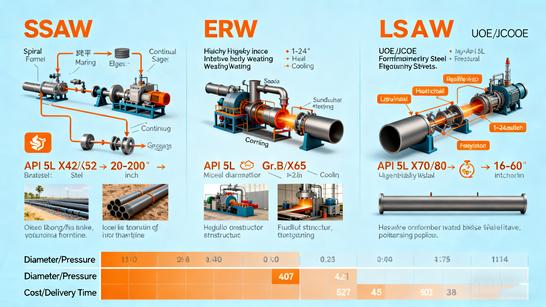
The reliability of ERW longitudinal weld steel pipe depends entirely on the manufacturing process. Unlike basic welders, industrial ERW uses high-frequency induction to fuse the edges perfectly. However, the true difference lies in post-production. To eliminate internal stresses at the weld seam, leading A53 Gr B carbon steel pipe suppliers perform Heat Treatment (Annealing). Furthermore, every single pipe must pass Hydrostatic testing—holding water under high pressure to ensure 100% leak-proof integrity before leaving the factory.
Table 2: Core Quality Control Standards (ASTM A53 ERW)
| Inspection / Test Item | Requirement / Standard | Purpose |
| Hydrostatic Test | Maintain for Min. 5 Seconds | Ensures zero leaks and no bursting under high-pressure conditions. |
| Weld Seam Annealing | Full-body or Localized Heat Treatment | Eliminates internal stress to prevent cracks at the weld zone. |
| Flattening Test | Flattened to specified distance without cracks | Verifies the ductility and bonding strength of the ERW longitudinal weld. |
| NDT (Ultrasonic/Eddy Current) | 100% Weld Seam Scanning | Detects internal micro-pores or slag inclusions invisible to the naked eye. |
A cheap pipe that fails the inspection is the most expensive pipe. Our hydrostatic testing reports come with every batch, ensuring 0% rejection rate at your port.
5. Primary Applications
ASTM A53 Grade B ERW is not just a pipe; it’s a versatile solution for diverse industrial infrastructures. Its high yield strength and reliable ERW longitudinal weld make it the top choice for:
-
Low-Pressure Fluid Transport: Ideal for water, gas, and air lines where cost-efficiency is as important as safety.
-
HVAC & Steam Systems: Specifically used in Schedule 40 for low-pressure steam and chilled water circulation.
-
Structural & Mechanical Use: Often used in piling, fencing, and scaffolding because its wall uniformity is superior to seamless pipes.
-
Oil & Gas Midstream: Suitable for gathering lines and processing plant piping where ASTM standards are mandatory.
6. Sourcing & Cost
The cost of ASTM A53 Grade B ERW per ton is influenced by more than just the steel market. To get the best ROI, savvy buyers look at:
-
Coating Options: Choose between "Black Steel" (lacquered) for temporary rust prevention or Galvanized for long-term corrosion resistance.
-
The "Seamless Trap": Stop overpaying for Type S (Seamless) if your operating pressure allows for Type E. Switching can save you up to 30% on material costs.
-
Logistics Strategy: Bundling orders or optimizing container loading for Schedule 40 pipes can significantly reduce your landed cost.
-
MTC Verification: Always demand a Mill Test Certificate (MTC) showing successful hydrostatic testing. A "cheap" pipe that fails at the port is the most expensive mistake you can make.
Table 3: Sourcing Decision Matrix (Application vs. Specification)
| Project Scenario | Recommended Specification | The "Why" (Strategic Benefit) |
| Indoor HVAC / Water Lines | Black ERW, Schedule 40 | Highest cost-efficiency; easiest for on-site installation. |
| Outdoor / Corrosive Environments | Galvanized ERW, Gr.B | Zinc coating extends rust-free lifespan by 5–10 times. |
| High-Pressure / Critical Chemicals | Type S (Seamless), Gr.B | Safety-first approach; required for extreme pressure ratings. |
| Structural / Piling / Fencing | ASTM A53 Gr.B ERW | Superior wall uniformity and higher bend/torsional strength. |
| Low-Pressure Steam (Under 150 psi) | ERW, Schedule 40/80 | Significant Cost-per-Ton savings compared to Seamless. |
By switching from Type S to our A53 Gr.B ERW, a typical 50-ton project saves enough to cover your entire shipping cost to the US/Europe. Let us run the math for you.