
In the realm of steel pipe production, welding stands as a pivotal process that determines the pipe's structural integrity, strength, and suitability for diverse applications. From the towering structures of urban skylines to the intricate networks of oil and gas pipelines, the quality of welds in steel pipes is of paramount importance. This article delves into the intricacies of various welding technologies employed in steel pipe production, including high - frequency welding and submerged arc welding, and underscores the significance of non - destructive testing in ensuring weld quality and safety.
1.High - Frequency Welding: Precision and Efficiency
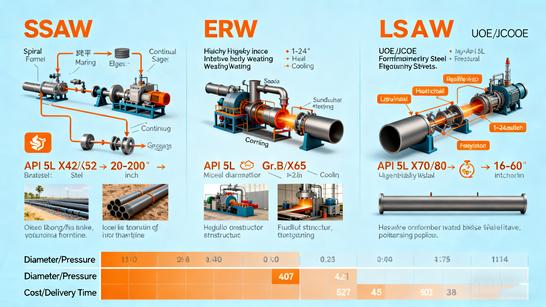
High - frequency welding is a widely used technique in the production of steel pipes, especially for straight - seam welded pipes (直缝管). This method operates on the principle of electromagnetic induction. A high - frequency alternating current is passed through a coil, which generates a high - frequency magnetic field. When a steel strip is fed through this magnetic field, eddy currents are induced in the strip, causing it to heat up rapidly. As the heated edges of the steel strip are brought together under pressure, they fuse to form a continuous weld.
One of the key advantages of high - frequency welding is its speed. The rapid heating and cooling process allow for high - volume production of steel pipes, making it an ideal choice for industries that require large quantities of pipes, such as the construction and water supply sectors. Additionally, high - frequency welding results in a narrow heat - affected zone (HAZ), which means that the properties of the base metal adjacent to the weld are less affected. This contributes to the overall strength and durability of the straight - seam welded pipes.
However, high - frequency welding also has its limitations. The quality of the weld can be influenced by factors such as the speed of the welding process, the thickness of the steel strip, and the accuracy of the edge preparation. If not properly controlled, defects such as lack of fusion or porosity may occur, which can compromise the pipe's integrity. Therefore, strict quality control measures are essential during high - frequency welding to ensure consistent weld quality.
2.Submerged Arc Welding: Deep Penetration and High Strength
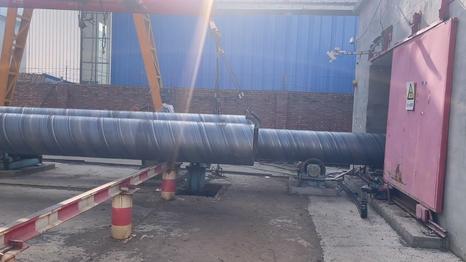
Submerged arc welding (SAW) is another prominent welding technology used in steel pipe production, often employed for both straight - seam and spiral - seam welded pipes. In this method, a continuous bare wire electrode is fed into the weld zone, and a layer of granular flux is poured over the arc and the weld pool. The flux serves multiple purposes: it shields the arc from the atmosphere, preventing oxidation and contamination; it stabilizes the arc, resulting in a more consistent weld; and it forms a slag layer on top of the weld, which protects the cooling weld metal and can be easily removed after solidification.
One of the most significant advantages of submerged arc welding is its ability to achieve deep penetration. This means that the weld can penetrate deeply into the base metal, creating a strong and durable joint. As a result, submerged arc - welded pipes are highly suitable for applications that require high - pressure resistance, such as oil and gas pipelines and power plant boilers. Moreover, the large amount of heat input during submerged arc welding allows for the welding of thick - walled pipes, expanding the range of applications for this technology.
However, submerged arc welding also has some drawbacks. The process is relatively slow compared to high - frequency welding, which can limit its use in high - volume production scenarios. Additionally, the large amount of flux used generates a significant amount of slag, which requires proper disposal to avoid environmental pollution.
3.The Importance of Non - Destructive Testing
Regardless of the welding technology used, ensuring the quality of welds in steel pipes is crucial for safety and reliability. Non - destructive testing (NDT) plays a vital role in this regard. NDT methods allow for the detection of defects in welds without damaging the pipe itself.
One common NDT method is ultrasonic testing (UT). UT uses high - frequency sound waves to inspect the internal structure of the weld. By analyzing the reflected sound waves, defects such as cracks, inclusions, and lack of fusion can be identified. Another widely used NDT method is radiographic testing (RT), which involves exposing the weld to X - rays or gamma rays. The resulting radiograph provides a detailed image of the weld's internal structure, allowing for the detection of hidden defects.
In addition to UT and RT, magnetic particle testing (MT) and liquid penetrant testing (PT) are also used for surface defect detection in steel pipes. These methods are relatively simple and cost - effective, making them suitable for routine inspections during the production process.
Conclusion
The art of welding in steel pipe production is a complex and highly specialized field. High - frequency welding and submerged arc welding are two of the most important welding technologies, each with its own set of advantages and limitations. High - frequency welding offers speed and precision, making it ideal for straight - seam welded pipes in high - volume production. Submerged arc welding, on the other hand, provides deep penetration and high strength, suitable for thick - walled pipes and high - pressure applications.
Non - destructive testing is an indispensable part of the welding process, ensuring that the welds in steel pipes meet the required quality standards. By combining advanced welding technologies with rigorous NDT methods, manufacturers can produce steel pipes that are not only strong and durable but also safe and reliable for a wide range of applications. In the ever - evolving world of steel pipe production, the continuous improvement of welding technologies and NDT methods will be key to meeting the growing demands of various industries.