
Introduction
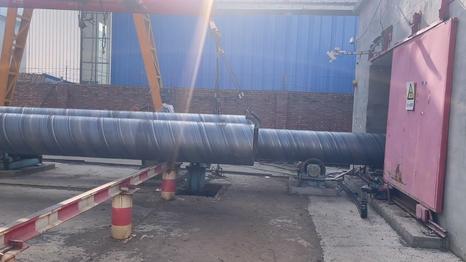
In the realm of steel pipe manufacturing, rolled & welded steel pipe stands out as a robust and versatile option, meeting a wide array of application requirements. Leveraging cutting - edge machinery and premium - quality materials, we are committed to producing rolled & welded pipes that precisely align with your project needs.
1.Manufacturing Plants and Sales Support
Our manufacturing plants are strategically located across the region, enabling us to effectively serve both private and public projects. Contractors seeking rolled and welded steel pipes can easily reach out to our dedicated sales representatives. Our team of seasoned experts is well - equipped to assist you in determining the exact specifications for your project. We prioritize on - time delivery, ensuring that your project stays on schedule and progresses smoothly towards completion. You can also request a quote from us to get an accurate cost estimate for your specific requirements.
2.Properties of Our Rolled & Welded Pipe
2.1 Size Versatility
Our rolled & welded pipes offer an impressive range of sizes. The outside diameters can reach up to 204 inches, providing options for large - scale projects that demand substantial pipe dimensions. Additionally, the wall thickness can go up to 2.25 inches, allowing for pipes that can withstand high - pressure and heavy - duty applications.
2.2 Customization Options
We understand that each project has unique needs. Therefore, we offer custom lengths and thicknesses to ensure that the pipes fit perfectly into your design. Our custom fabrication services further enhance this flexibility, enabling us to create pipes with specific shapes or features as required.
2.3 Testing Capabilities
To guarantee the quality and reliability of our pipes, we have both in - house and third - party testing capabilities. These tests cover various aspects such as structural integrity, weld quality, and pressure resistance, giving you confidence in the performance of our products.
3.Applications of Rolled & Welded Steel Pipe
3.1 Bearing Piles
In construction projects where shallow soils lack the strength to support the loads from a structure, deep foundations are necessary. Pipe piles, a common choice for deep foundations, transfer loads from the building to stronger soil layers deep underground. This load transfer occurs through skin friction and point bearing. Pipe piles can be driven either open - ended or closed - ended, with points or plates. When driven with plates, the pipes can be filled with concrete to enhance their strength. Although using plates, rebar, and concrete is an option, it is often more cost - effective to opt for a larger, thicker pile. Pipe piles come in a range of sizes, from several inches to several feet in diameter, and can be easily spliced to create piles hundreds of feet long.
3.2 Drilled Shaft Casing
During the construction of drilled shafts, pipe casing, whether temporary or permanent, is often required. The casing holds the hole open while the reinforcement cage and concrete are installed. This allows for a thorough inspection of the bottom of the hole and ensures a consistent diameter for the finished drilled shaft, resulting in a higher - quality pile. According to the "Standard Guidelines for the Design and Installation of Pile Foundations" by ASCE, drilled shafts without casing have a 38% lower factor of safety in terms of structural capacity compared to those with casing.
3.3 Structural Sections
The symmetry of pipe gives it equal bending strength in all directions, making it an excellent choice for resisting buckling. The stress required to buckle an axial member decreases with length, while the radius of gyration has the opposite effect, increasing a section's ability to resist buckling. Unlike W and HP sections, which have different radii of gyration (rx and ry) for the X and Y axes, a pipe's radius of gyration remains constant. As a result, a pipe can withstand much higher loads over long, unsupported lengths.
3.4 Combination Walls
Large - diameter pipes, with their high bending strengths, are frequently used in combination sheet pile walls. The combination of large - diameter pipe piles and steel sheet piles, often referred to as combi - walls, pipe - z walls, or king pile walls, forms a highly efficient system. In this setup, the king pile takes on the majority of the load, while the sheet pile transfers the load to the pipe and the soil.
3.5 Threaded Micropile Casing
Micropiles are small - diameter, bored cast - in - place piles, with most of the applied load being resisted by steel reinforcement. They are constructed by drilling a borehole, often using casing, then placing steel reinforcement and grouting the hole. Micropiles have a wide range of applications, including supporting and resupporting foundations, seismic retrofits, slope stabilization, and earth retention. They are ideal for complex sites where low vibration or low noise levels are required, or where access is limited, such as in areas with low headroom and difficult drilling conditions.
3.6 Mining
Mining operations occur deep underground in hazardous conditions, involving personnel, equipment, and air shafts. Vertical pipe sections are commonly used to construct these shafts. The wide range of diameters and thicknesses available makes steel pipe the preferred material for various shaft requirements. Some shafts can be hundreds or even thousands of feet long, and pipes can be supplied in sections with prepped ends for splicing. Bracing rings can be used to minimize pipe thickness.
3.7 Sign Poles, Towers, & Transmission Lines
Sign poles and towers are designed to withstand large bending loads at their bases. The availability of large - diameter pipes in a wide variety of thicknesses allows designers to select the exact size needed for their specific projects. Pipes can also be supplied in very long lengths, are easy to splice, and can be drilled into hard ground. Reduction collars can facilitate the splicing of different diameters to optimize the design.
3.8 Jacked & Bored Pipe
The placement of underground utilities is often achieved using jacked and bored pipe. Sections of pipe are pushed through the ground with hydraulic jacks between excavations or under a hill. Subsequent sections are then spliced on, and the jacking continues until completion. After jacking, the pipe is cleaned out to install the utilities, avoiding extensive excavation that could disrupt roads, railroads, homes, and businesses.
3.9 Sewer/Water Line Pipe
Welded steel pipe is an effective means of transporting liquids, air, and gas. It is pound - for - pound stronger than other types of line pipe and can be designed to handle both internal and external pressures in most applications. Welded steel pipe offers advantages such as strength, economy, and ease of installation. We are SPFA certified and manufacture hydrostatically tested pipe with outside diameters ranging from 10 - 3/4" to 90". Our production process uses a double submerged arc weld process for both spiralweld and rolled & welded pipe. Hydrostatically tested pipe lengths range from 30' to 60', with wall thicknesses from 0.250" to 2.0", produced according to industry standards such as AWWA C200/ASTM A139/ASTM A134.
4.Manufacturing Process
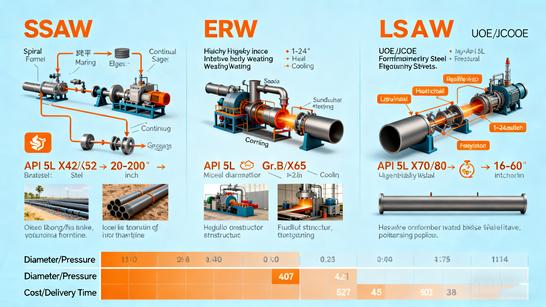
The production of rolled & welded pipe is one of the oldest steel pipe manufacturing processes. It is employed when the pipe wall thickness exceeds the capabilities of high - frequency electric resistance weld (ERW) pipe and spiralweld pipe manufacturing processes.
(1) Plate Acquisition:The raw material, pieces of flat steel plate, are received at our manufacturing plant.
(2)Cutting:A single flat sheet of steel plate is cut on a burning table using plasma or cutting gases. The plate is cut to the required width and length for each individual can that will form the final product.
(3)Beveling:After cutting, the plate is transferred to the beveling station, where the plate edges are beveled and prepped for welding.