
Introduction
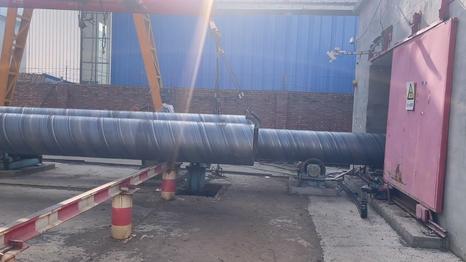
In the world of critical infrastructure—be it oil, gas, or water transmission—the phrase "a chain is only as strong as its weakest link" translates literally to the weld seam of a pipe. Although a visual inspection might show a smooth pipe surface, the true key to the pipe's strength lies in its internal seams. For Spiral Submerged Arc Welded (SSAW) pipes, the integrity of that continuous spiral seam is paramount.
Why the Spiral Seam Demands Precision?
Unlike straight seam steel pipes, the spiral weld seam of a spiral pipe is significantly longer than the pipe itself. While this geometry offers superior resistance to internal pressure, it also means the manufacturing process must be flawless. To guarantee this, we employ a multi-stage Non-Destructive Testing (NDT) protocol:
1. Online Ultrasonic Testing: As the pipe is formed and welded, sensors scan the seam in real-time to detect any immediate discontinuities.
- What it detects: Precise depth and location of subsurface flaws, such as lack of fusion or incomplete penetration.
- The Advantage: It is highly sensitive to linear defects and provides immediate feedback, allowing for rapid adjustments in the production line.
2. X-Ray Inspection: The "Gold Standard" for internal defects. We use X-ray imaging to inspect the pipe ends and any suspicious areas identified by UT to ensure zero porosity or slag inclusion.
- What it detects: Internal gas pockets (porosity), slag inclusions, and cracks.
- The Advantage: It provides a permanent film or digital record of the weld quality, offering indisputable proof of integrity for project stakeholders.
3. Hydrostatic Testing: Every single pipe is filled with water and pressurized to its limit to ensure it won't fail under real-world operating conditions.
Why Advanced NDT Matters for Your Project
-
Failure Prevention: Identifying microscopic cracks before they expand under high pressure prevents catastrophic environmental and financial disasters.
-
Extended Service Life: Pipes verified by rigorous NDT are proven to withstand corrosion and mechanical stress more effectively over decades.
-
Regulatory Compliance: Ensure your project adheres to API 5L, ASTM, and ISO requirements, facilitating smooth inspections and insurance approvals.
Beyond the surface of every SSAW pipe lies a complex weld structure that must be flawless. By integrating state-of-the-art X-ray and Ultrasonic inspection, manufacturers can guarantee that their spiral welded steel pipes aren't just conduits, but reliable pillars of modern infrastructure. When you source high-strength spiral steel pipes for a project, you aren't just buying steel; you are buying the assurance that the pipeline will last 50+ years underground. By adhering to API 5L and ASTM standards, our NDT process ensures that every millimeter of the spiral seam is as strong as the base metal itself.
Technical Specifications: Spiral Submerged Arc Welded (SSAW) Steel Pipe
1. Key Dimensions & Specifications
| Parameters | Specification Range | Reference Standards |
| Outer Diameter | 219mm – 3220mm (8" – 126") | API 5L, ASTM A252, EN10219 |
| Wall Thickness | 5.0mm – 25.4mm | SCH 10 - SCH 80 / STD |
| Length | 6m – 12m (Single Random/Double Random) | Customizable up to 18m |
| Steel Grade | Q235B, Q345B, Grade B, X42, X52, X60, X70 | API 5L Spec |
| End Finish | Beveled End, Square Cut | Protective caps applied |
2. Standard Tolerances for SSAW Pipe
| Inspection Item | Tolerance per API 5L | Remarks |
| OD Tolerance | ±0.75% of OD (Pipe body) | ±0.5% for pipe ends |
| WT Tolerance | +15% / -12.5% | Based on steel grade |
| Straightness | ≤ 0.2% of total length | Critical for piling projects |
| Out-of-roundness | ≤ 1% of nominal OD | Measured at the ends |
| Weld Reinforcement | Internal: 0.5-3.5mm / External: 0.5-4.0mm | Prevents stress concentration |
“Precision Fit”:
“Our strict control over Out-of-roundness (≤ 1%) ensures that when your team is welding in the field, the pipes align perfectly, reducing labor costs and welding defects.”
“For large-diameter water transmission, our capability to produce OD up to 3220mm with consistent WT tolerance makes us a reliable partner for infrastructure giants.”