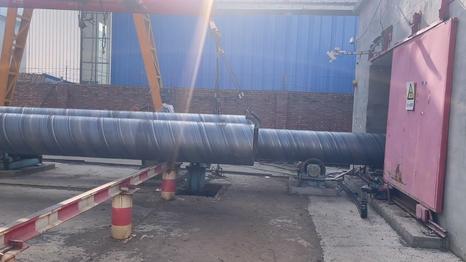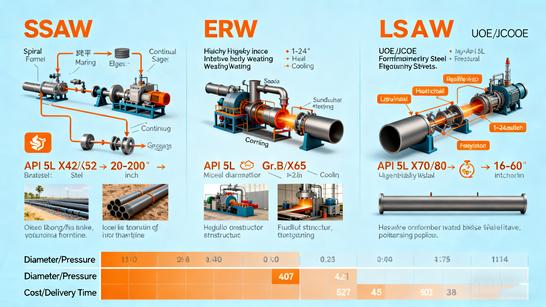

Spiral welded pipes, as a highly efficient and economical pipeline solution, demonstrate superior performance in various fields such as oil, natural gas, water treatment, and building structures thanks to their unique spiral forming process. This article will delve into the technical characteristics, manufacturing process, application areas, and future development trends of spiral welded pipes. We will also briefly introduce several high-quality steel pipe products based on similar technical concepts but optimized for different application scenarios, including [Varnished ERW Steel Pipe], [ FBE Coated ERW Steel Pipe], [3PE Coated LSAW Steel Pipe], and [Fire Sprinkler Galvanized Steel Pipe], providing comprehensive reference for industry professionals and those outside the industry.
I. Technical Characteristics of Spiral Welded Pipes
Spiral welded pipes are formed by spirally coiling and welding strip steel. Their unique manufacturing process endows them with a series of advantages:
High Strength and Toughness: The spiral welding method effectively disperses welding stress, improving the overall strength and toughness of the pipeline.
High Adaptability:Capable of producing large-diameter, long-distance pipelines to meet diverse engineering needs.
Cost-Effectiveness:Compared to straight-seam welded pipes, spiral welded pipes offer advantages in material utilization and production efficiency, reducing costs.
II. Detailed Manufacturing Process
The manufacturing process of spiral welded pipes mainly includes raw material preparation, forming, welding, cutting, inspection, and anti-corrosion treatment. Forming and welding are key steps, employing advanced automated equipment to ensure stable and reliable welding quality. Furthermore, the application of anti-corrosion treatments such as [FBE (fusion-bonded epoxy powder) coating] and [3PE (triple-layer polyethylene) coating] further extends the pipeline's service life.
III. Application Areas and Case Studies
Spiral welded pipes are widely used in various fields such as oil and gas transportation, urban water supply and drainage, chemical pipelines, and bridge construction. For example, in oil and gas transportation, their high strength and corrosion resistance ensure the safety and efficiency of long-distance transportation; in urban water supply systems, spiral welded pipes, with their excellent sealing and durability, guarantee the safety and stability of residents' water supply.
IV. Future Development Trends
With increasing environmental awareness and continuous technological advancements, the spiral welded pipe industry is developing towards a more environmentally friendly, efficient, and intelligent direction. The application of new materials and processes will further enhance pipeline performance. Simultaneously, the introduction of intelligent monitoring and maintenance systems will enable remote monitoring and intelligent management of pipeline systems, improving operation and maintenance efficiency.
Spiral welded pipes, with their unique technological advantages and broad application prospects, occupy a pivotal position in the pipeline industry. Products optimized based on similar technological concepts, such as Varnished ERW Steel Pipe, FBE Coated ERW Steel Pipe, 3PE Coated LSAW Steel Pipe, and Fire Sprinkler Galvanized Steel Pipe, provide customized solutions for different application scenarios, meeting the diversified needs of the market. In the future, with continuous technological innovation and upgrading, we have reason to believe that spiral welded pipes and their derivative products will play an important role in more fields, driving the sustainable development of the pipeline industry.