
Introduction
In the ever-evolving landscape of the steel pipe industry, Electric Resistance Welded (ERW) pipe technology has emerged as a game-changer. Offering a cost-effective and efficient alternative to traditional seamless pipes, ERW pipes have found widespread applications across various sectors, from construction and infrastructure to oil and gas transportation. This article delves into the intricate mechanics of ERW pipe production, exploring each stage in detail, and highlights the numerous benefits that make ERW pipes a preferred choice for many projects. Additionally, we will compare ERW pipes with other pipe types to provide a comprehensive understanding of their unique advantages.
1.Mechanics of ERW Pipe Production
The production of ERW pipes involves a series of well-defined stages, each contributing to the final product's quality and performance. Let's take a closer look at these stages:
1.1 Pre-forming Stage
The journey of an ERW pipe begins with the selection of high-quality steel strip, which serves as the raw material. This strip is then fed into a pre-forming machine, where it undergoes a series of rollers that gradually shape it into a cylindrical form. This pre-forming stage is crucial as it ensures uniform wall thickness throughout the pipe, laying the foundation for a strong and durable final product. The precision of this stage is vital, as any irregularities in wall thickness can lead to weaknesses in the pipe, compromising its integrity under pressure.
1.2 Welding Process
Once the steel strip has been shaped into a cylindrical form, it enters the welding stage, where the magic of electric resistance welding takes place. In this process, high-frequency electrical currents are passed through the edges of the strip, generating intense heat that melts the metal. As the edges melt, they fuse together, creating a strong bond without the need for any filler material. This welding technique not only ensures a seamless connection but also maintains the pipe's structural integrity, making it capable of withstanding significant pressures and loads. The absence of filler material also reduces the risk of corrosion and leakage, enhancing the pipe's longevity and reliability.
1.3 Sizing and Finishing
After the welding process is complete, the newly formed pipe undergoes sizing and finishing operations to achieve its final dimensions and surface quality. The sizing stage involves passing the pipe through a series of dies that gradually reduce its diameter to the desired size while maintaining its cylindrical shape. This process ensures that the pipe meets the specified dimensions with high precision, making it suitable for various applications that require exact measurements. Following sizing, the pipe undergoes finishing operations, such as straightening and surface treatment, to enhance its appearance and performance. Straightening ensures that the pipe is free from any bends or distortions, while surface treatment, such as painting or coating, provides protection against corrosion and improves the pipe's aesthetic appeal.
2.Benefits of ERW Pipes
ERW pipes offer a plethora of benefits that make them a preferred choice for many projects. Let's explore some of these advantages in detail:
2.1 Cost-Effectiveness
One of the most significant advantages of ERW pipes is their cost-effectiveness. Compared to seamless pipes, which require a more complex and time-consuming production process, ERW pipes are manufactured using a simpler and faster method. This simplicity in production translates into lower manufacturing costs, making ERW pipes more affordable for businesses and consumers alike. Additionally, the higher production speeds of ERW pipes enable manufacturers to produce large quantities in a shorter period, further reducing costs and increasing efficiency.
2.2 Uniform Quality
The automated nature of ERW pipe production ensures consistent quality across all pipes. Unlike manual welding processes, which are prone to human error and inconsistencies, electric resistance welding provides a high level of precision and control. This automation reduces the risk of defects, such as weld failures or irregular wall thickness, ensuring that each pipe meets the specified standards and requirements. The uniform quality of ERW pipes enhances their reliability and performance, making them suitable for critical applications where safety and durability are paramount.
2.3 Versatility
ERW pipes are highly versatile and can be produced in a wide range of sizes and thicknesses. This versatility makes them suitable for various applications, from small-diameter pipes used in residential plumbing to large-diameter pipes used in industrial piping systems. The ability to customize the dimensions of ERW pipes allows businesses to select the most appropriate pipe for their specific needs, ensuring optimal performance and efficiency. Additionally, ERW pipes can be made from different types of steel, such as carbon steel or stainless steel, providing further flexibility in terms of material selection and application suitability.
2.4 Environmental Sustainability
In today's world, environmental sustainability is a crucial consideration for many businesses and consumers. ERW pipes contribute to environmental sustainability in several ways. Firstly, their production process generates less waste compared to seamless pipes, as there is no need for cutting and discarding excess material. Secondly, ERW pipes can be recycled and reused, reducing the demand for new raw materials and minimizing the environmental impact of pipe production. Finally, the energy efficiency of ERW pipe production, due to its automated and streamlined nature, helps to reduce energy consumption and greenhouse gas emissions, further promoting environmental sustainability.
3.Comparing ERW with Other Pipe Types
To provide a comprehensive understanding of ERW pipes, let's compare them with other pipe types, highlighting their unique advantages and disadvantages:
3.1 ERW vs. Seamless Pipes
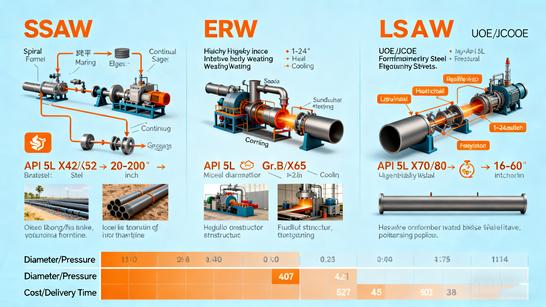
Seamless pipes are known for their superior strength and pressure resistance, making them suitable for high-pressure applications, such as oil and gas transportation. However, seamless pipes are more expensive to produce due to their complex manufacturing process, which involves piercing a solid billet and rolling it into a pipe shape. In contrast, ERW pipes are more cost-effective and easier to produce in large quantities, making them a preferred choice for applications where cost is a significant factor. While seamless pipes may offer better performance in extreme conditions, ERW pipes provide a reliable and economical solution for many standard applications.
3.2 ERW vs. Spiral Pipes
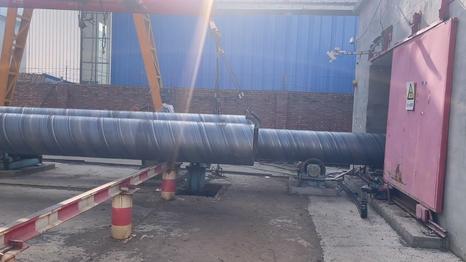
Spiral pipes are another type of welded pipe that excel in producing large-diameter pipes. They are manufactured by winding a steel strip around a mandrel at an angle, creating a spiral seam that is then welded together. Spiral pipes are suitable for applications that require large-diameter pipes, such as sewage systems or large-scale water transportation. However, ERW pipes are better suited for smaller diameters and applications requiring precise dimensions. The straight seam of ERW pipes provides better dimensional accuracy and a smoother surface finish, making them ideal for applications where these factors are critical.
Conclusion
ERW pipe technology offers a compelling combination of cost-effectiveness, uniform quality, versatility, and environmental sustainability. By understanding its mechanics and benefits, businesses can make informed decisions when selecting pipes for their projects. Whether it's for construction, infrastructure, or industrial applications, ERW pipes provide a reliable and economical solution that meets the diverse needs of modern industries. As the steel pipe industry continues to evolve, ERW pipe technology is poised to play an increasingly important role, driving innovation and efficiency in pipe production and usage.[Back to Comprehensive Guide to Spiral and ERW Steel Pipes in China: Production, Standards, and Applications]