
1. Introduction: The Evolution of Welded Steel Pipes
Welded steel pipes—particularly spiral welded (SSAW) and longitudinal welded (LSAW) pipes—have become essential in modern infrastructure. From oil and gas transmission to structural and water supply projects, these pipes combine strength, cost-efficiency, and reliability.
This guide explores their manufacturing processes, performance characteristics, international standards, and practical application scenarios, helping engineers and buyers make informed choices for long-term project reliability.
2. Understanding the Two Main Types of Welded Pipes
2.1 Spiral Welded Steel Pipe (SSAW)
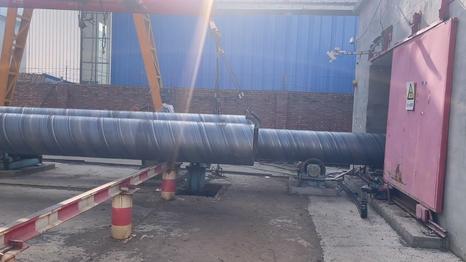
Spiral Submerged Arc Welded (SSAW) pipes are manufactured by helically forming hot-rolled steel coils and welding the seam spirally along the pipe.
This technique allows for the production of large-diameter pipes using narrower plates, optimizing material utilization.
Key Features:
-
Continuous spiral weld offers uniform strength distribution.
-
Excellent flexibility for varying diameters and wall thicknesses.
-
Typically used in low-to-medium pressure applications such as water transport, piling, and structural supports.
Advantages:
-
Cost-effective for large diameters (≥Φ406mm).
-
High production efficiency and adaptability to diverse project demands.
Limitations:
-
Less suitable for high-pressure or high-temperature service compared to seamless or LSAW pipes.
-
Requires strict NDT (non-destructive testing) to ensure weld integrity.
2.2 Longitudinal Welded Steel Pipe (LSAW)
Longitudinal Submerged Arc Welded (LSAW) pipes are made by forming and welding steel plates along a straight seam.
They provide excellent dimensional accuracy and superior performance under high stress.
Key Features:
-
Uniform wall thickness and precise geometry.
-
Double-sided submerged arc welding (inside & outside) for strength and durability.
-
Commonly used in oil & gas pipelines, structural columns, and offshore engineering.
Advantages:
-
Excellent mechanical properties for high-pressure fluid transmission.
-
Superior resistance to deformation and cracking.
-
Compliant with major standards such as API 5L, ASTM A252, and EN 10219.
Limitations:
-
Higher production cost than SSAW.
-
More limited flexibility for very large diameters compared to spiral welded pipes.
3. Material Grades and International Standards
| Standard | Typical Grades | Application |
|---|---|---|
| API 5L | Gr. B, X42–X80 | Oil & gas transmission pipelines |
| ASTM A252 | Gr. 1, 2, 3 | Structural and piling applications |
| EN 10219 / EN 10210 | S235, S355 | Structural and mechanical use |
| GB/T 9711 | L245–L555 | Natural gas and petroleum systems |
| ISO 3183 | PSL1, PSL2 | International oil pipeline systems |
Note: For corrosive or seawater environments, internal/external coating such as 3LPE/3LPP, FBE, or bituminous layers are recommended.
4. Comparison Between SSAW and LSAW Pipes
| Aspect | SSAW (Spiral Welded) | LSAW (Longitudinal Welded) |
|---|---|---|
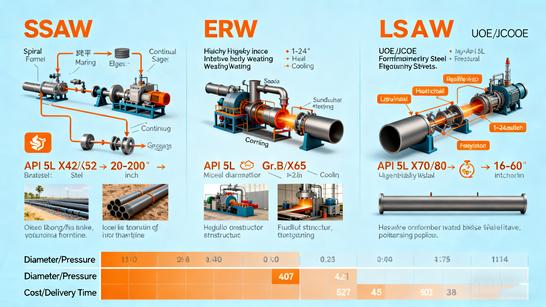
| Manufacturing Process | Spiral forming + double-side submerged arc welding | Plate forming + straight seam welding |
| Diameter Range | 406–2500 mm | 406–1422 mm |
| Wall Thickness | 5–25 mm | 6–50 mm |
| Pressure Rating | Medium | High |
| Weld Strength | Multi-directional stress | Linear, high tensile integrity |
| Applications | Water transport, piling, structural | Oil & gas transmission, offshore |
| Standards | SY/T5037, ASTM A252, EN10219 | API 5L, ASTM A53, EN10217 |
5. Application Scenarios
-
Oil & Gas Industry:
-
LSAW pipes are the preferred option for long-distance transmission pipelines, owing to their high-pressure capacity and toughness.
-
-
Water Supply & Sewage Systems:
-
SSAW pipes offer a cost-effective solution for municipal water delivery, irrigation, and drainage systems.
-
-
Structural Engineering & Piling:
-
SSAW and LSAW pipes are widely used for bridge piles, foundation supports, and marine structures due to their excellent compressive strength.
-
-
Offshore & Energy Projects:
-
LSAW pipes comply with stringent offshore engineering standards, making them suitable for subsea pipelines and platform supports.
-
6. Quality Inspection and Testing
High-quality welded pipes undergo rigorous testing to ensure reliability and standard compliance:
-
Non-destructive testing (UT, RT, MT, PT)
-
Hydrostatic pressure test
-
Dimensional inspection
-
Mechanical & chemical analysis
-
Coating adhesion and thickness testing
Partnering with a supplier that supports third-party inspection (TPI)—such as SGS, BV, or Intertek—ensures full transparency and product traceability.
7. Conclusion: Selecting the Right Pipe for the Right Purpose
Choosing between Spiral Welded (SSAW) and Longitudinal Welded (LSAW) pipes depends on the project’s specific requirements:
-
For high-pressure and high-strength systems → choose LSAW.
-
For large-diameter, low-pressure water or structural systems → SSAW provides cost advantages.
By aligning the pipe type, standard, and application environment, project owners can achieve a balance between performance, safety, and cost-efficiency—ensuring a reliable pipeline system for decades.